


Rice University Athletics
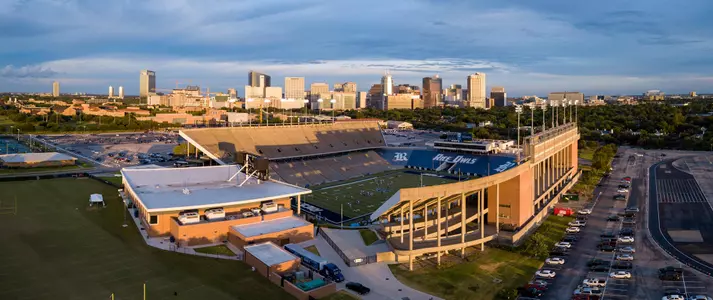
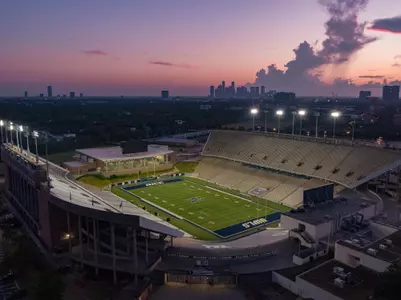
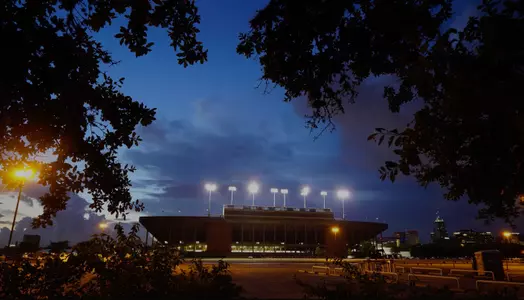
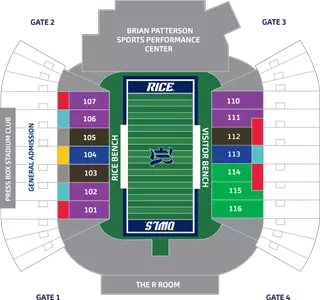
Capacity: 47,000
Year Opened: 1950
Highlights: Brian Patterson Sports Performance Center Dedication (2016);
Super Bowl VIII (1974)
Conference USA Championship Game (2013)
John F. Kennedy Speech (1962)
Rice defeats #1 Texas A&M (1957)
Final Game in the Southwest Conference (1994)
First Community Stadium turns 76 in 2026, a season that will mark the beginning of a transformational period for one of Houston’s most iconic sporting venues.
A landmark on the college football circuit since its debut in 1950, First Community Stadium will soon be the centerpiece of Rice University’s The Gateway Project, a comprehensive renovation of the venerable facility that will enhance the fan experience and provide greater flexibility for hosting a wide variety of events.
The new initiative will be a quantum leap forward for the facility, which has undergone a series of upgrades to its current configuration over the years, including a new TenCate Pivot surface installed before the 2024 season.
The R Room, which debuted in 1972, underwent major modernization in the summer of 2023. The south end zone club area was completely reimagined and added state-of-the-art audiovisual features, including a new sound system and televisions, offering fans crystal-clear viewing and immersive game-day excitement. The space will continue to honor the program's storied history and legendary figures, including Hall of Fame members, All-Americans, and conference champion teams.
A pair of party decks were added at the Northwest and Southeast corners of the stadium, while improved WiFi connectivity and TV installations throughout the stadium enhance fans’ digital access to the game.
Upgraded premium seating options were installed on the stadium's west side before the 2021 season, and eight Flight Deck loge boxes on the east side. Energy-efficient LED lighting was installed on the concourses while the concourse floors were resurfaced. The interior walls of the field level were resurfaced with brick, adding Rice’s signature campus aesthetic to the stadium. The south scoreboard above the R Room was also replaced by a new Daktronics board.
The cornerstone of these upgrades is the Brian Patterson Sports Performance Center, which opened in August 2016.
In addition to representing a spectacular upgrade for Rice student-athletes, the facility ushered in a new era for fans with the installation of the Daktronics video system in 2016. The main video display measures 29 feet high by 49 feet wide and features a 13HD pixel layout for excellent image quality and contrast with wide-angle visibility to appeal to every seat in the stadium. The production center for the video board positioned Rice Athletics to produce network-quality broadcasts, allowing the school to seamlessly transition to the ESPN+ streaming platform.
The current artificial playing surface is the latest since the stadium first switched from grass in 1970. As part of Rice hosting the Atlanta Falcons for their practices before Super Bowl LI, the grass practice field north of the Patterson Center also received a major overhaul.
First Community Stadium has a storied history of its own, but its creation was the result of arguably the greatest season in school history.
Led by Froggy Williams and Joe Watson, Rice captured the 1949 Southwest Conference championship, blasted #19 North Carolina in the Cotton Bowl to end the year 10-1, and ranked fifth in the final AP poll.
The original First Community Stadium (now the home for Rice track and soccer) seated less than 37,000 fans, many of whom were installed temporarily for football each fall. Rice administrators and Houston’s civic leaders decided that the existing structure was no longer a proper venue for the SWC champions or for a booming city. Public response to a call for commitments for seats at a new venue was overwhelming, and the project was set in motion with the unlikely goal of opening its gates in time for the upcoming 1950 season.
Brown & Root, Inc. was the general contractor for the project, and the groundbreaking was held in February 1950. Working feverishly on 24-hour shifts over the next eight months, the completed stadium was ready for the showdown between the defending Cotton and Orange Bowl champions as Rice defeated Santa Clara 27-7 on Sept. 30, 1950.
Rice Football has twice matched its historic 1949 win total after moving to its new home, first in 2008 and again in 2013, with the 10th win coming as the Owls defeated Marshall to win the Conference USA Championship.
First Community Stadium has been the scene of many exciting moments in the City of Houston's football legacy. At various times, the stadium has served as the home stadium for the Bluebonnet Bowl, the University of Houston, Texas Southern University, and the Houston Oilers. In 2021, the stadium served as one of two host pods for The Spring League and hosted its championship game, The Mega Bowl. In 2023, it was the home field for the Houston Roughnecks in the inaugural season of the UFL.
On January 13, 1974, First Community Stadium hosted Super Bowl VIII, in which the Miami Dolphins defeated the Minnesota Vikings 24-7. First Community Stadium is one of only three campus facilities still in operation that have hosted a Super Bowl (Sun Devil Stadium and Stanford Stadium are the others). Tulane hosted three Super Bowls at Sugar Bowl Stadium before demolishing it in 1979.
In the fall of 2020, the west concourse of the stadium served as an early voting location, and in the spring of 2021, the same area hosted a vaccination clinic.
That same spring, undergraduate commencement ceremonies were moved to the stadium for the first time and are now held each May annually.
Over the years, the stadium has held major concerts, including Pink Floyd, Eagles, Elton John\Billy Joel, and George Strait.
More than 11,000,000 fans have watched Rice Owls football at First Community Stadium.